Recent News
02/20/2026
To maximize — or not to maximize — depreciation deductions on your 2025 tax return
The deadlines for filing 2025 tax returns (or extensions) are fast approaching. Although most tax planning moves must be completed by December 31 of the tax year, there are some decisions you can make when filing your return that can save taxes now or in the future. One such decision is whether to claim accelerated depreciation breaks. Depreciation Basics For assets with a useful life of more than one year, the cost generally must be depreciated over a period of years (unless accelerated depreciation breaks are available). In other words, taxpayers can deduct only a portion of the asset’s cost...

Stay up to date! Subscribe to our future blog posts!

05/03/2024
B2B businesses need a cohesive strategy for collections
If your company operates in the business-to-business (B2B) marketplace, you’ve probably experienced some collections challenges. Every company, whether buyer or seller, is trying to manage cash flow. That means customers will often push off payments as long as possible to retain those dollars. Meanwhile, your business, as the seller, needs the money to meet its revenue and cash flow goals. There’s no easy solution, of course. But you can “grease the wheels,” so to speak, by strategically devising and continuously improving a methodical collections process. Payment terms Getting paid promptly depends, at least in part, on the terms you set forth...

04/26/2024
When businesses may want to take a contrary approach with income and deductions
Businesses usually want to delay recognition of taxable income into future years and accelerate deductions into the current year. But when is it wise to do the opposite? And why would you want to? One reason might be tax law changes that raise tax rates. The Biden administration has proposed raising the corporate federal income tax rate from its current flat 21% to 28%. Another reason may be because you expect your noncorporate pass-through entity business to pay taxes at higher rates in the future and the pass-through income will be taxed on your personal return. There have also been...

04/19/2024
Don’t have a tax-favored retirement plan? Set one up now
If your business doesn’t already have a retirement plan, it might be a good time to take the plunge. Current retirement plan rules allow for significant tax-deductible contributions. For example, if you’re self-employed and set up a SEP-IRA, you can contribute up to 20% of your self-employment earnings, with a maximum contribution of $69,000 for 2024 (up from $66,000 for 2023). If you’re employed by your own corporation, up to 25% of your salary can be contributed to your account, with a maximum contribution of $69,000. If you’re in the 32% federal income tax bracket, making a maximum contribution could...

04/12/2024
Scrupulous records and legitimate business expenses are the key to less painful IRS audits
If you operate a business, or you’re starting a new one, you know records of income and expenses need to be kept. Specifically, you should carefully record expenses to claim all the tax deductions to which you’re entitled. And you want to make sure you can defend the amounts reported on your tax returns in case you’re ever audited by the IRS. Be aware that there’s no one way to keep business records. On its website, the IRS states: “You can choose any recordkeeping system suited to your business that clearly shows your income and expenses.” But there are strict...
04/05/2024
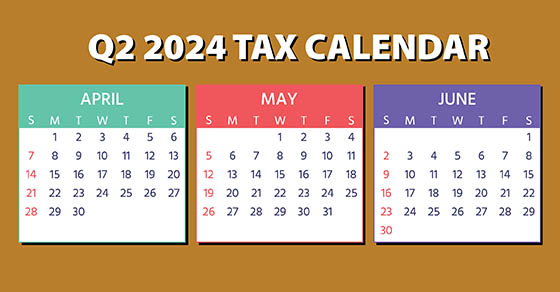
2024 Q2 tax calendar: Key deadlines for businesses and employers
Here are some of the key tax-related deadlines that apply to businesses and other employers during the second quarter of 2024. Keep in mind that this list isn’t all-inclusive, so there may be additional deadlines that apply to you. Contact us to ensure you’re meeting all applicable deadlines and to learn more about the filing requirements. April 15 If you’re a calendar-year corporation, file a 2023 income tax return (Form 1120) or file for an automatic six-month extension (Form 7004) and pay any tax due. For corporations, pay the first installment of 2024 estimated income taxes. Complete and retain Form...

03/29/2024
Business owners, your financial statements are trying to tell you something
Business owners are commonly and rightfully urged to regularly generate financial statements in compliance with Generally Accepted Accounting Principles (GAAP). One reason why is external users of financial statements, such as lenders and investors, place greater trust in financial reporting done under the rigorous standards of GAAP. But that’s not the only reason. GAAP-compliant financial statements can reveal details of your company’s financial performance that you and your leadership team may otherwise not notice until a major problem has developed. Earnings are only the beginning Let’s begin with the income statement (also known as the profit and loss statement). It provides...